It was November 2020. A 19-year-old kid from Atlanta, Georgia, sat in front of a camera in an empty room — no green room, no crowd, no fanfare — waiting to hear his name called in a draft that COVID had stripped of its usual drama.
When the Minnesota Timberwolves made Anthony Edwards the first overall pick, the reaction was lukewarm at best. Critics called the class weak. Scouts flagged his shot selection. Some openly wondered if LaMelo Ball should have gone first.
Five years later, that conversation is over. Edwards has become one of the most electrifying players the NBA has seen in a generation — a four-time All-Star, an Olympic gold medalist, and the undisputed face of a Timberwolves franchise that had been basketball’s punchline for the better part of two decades.
The story of Anthony Edwards’ career is one of the most compelling rises in recent NBA history. And it is still being written.
Why the Timberwolves Bet Everything on a 19-Year-Old from Atlanta
The 2020 NBA Draft was a gamble, no matter who Minnesota picked. The class was thin at the top. James Wiseman had played just three college games. LaMelo Ball had spent the previous year playing professionally in Australia before injuring his foot.
Edwards was the safest bet, but safety is relative when you’re talking about a teenager who shot 40 percent from the field at Georgia and whose Bulldogs finished 16-16.
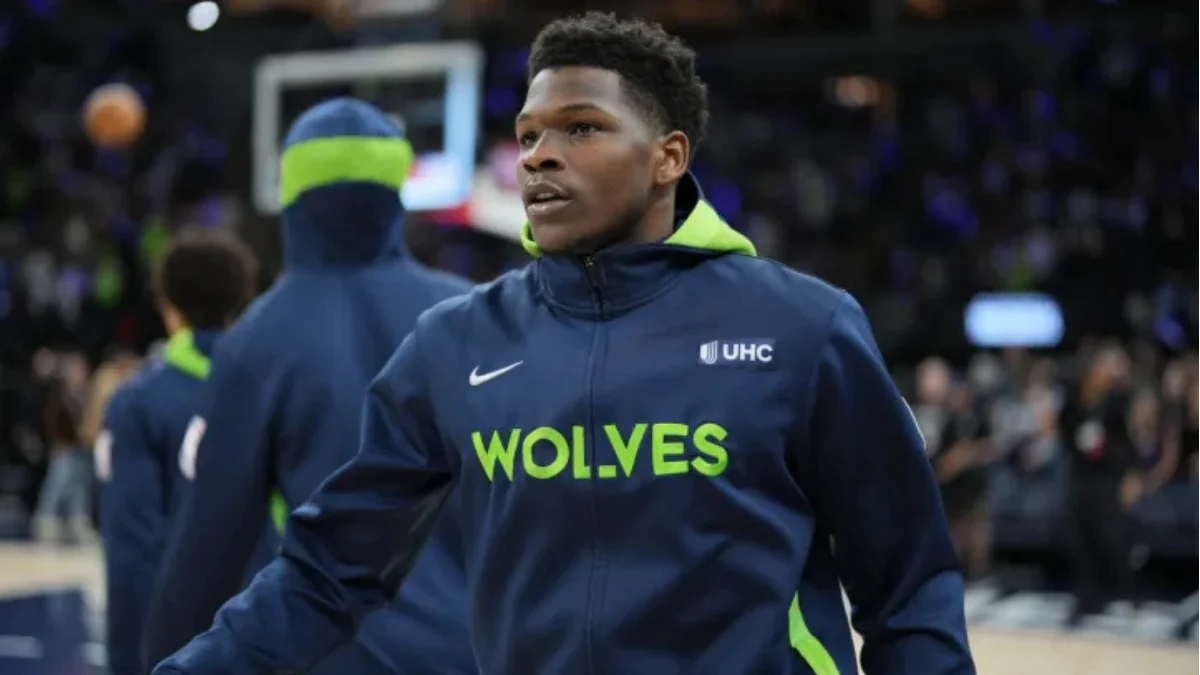
What scouts saw in Edwards was something that does not show up in box scores. He had a body built for the NBA at 6’4″ and 225 pounds, with lateral quickness that made defensive coordinators nervous. Georgia coach Tom Crean said he had never coached anyone with that level of force in his feet. That ankle stability and foot strength, coaches noted, was the same trait shared by Dwyane Wade, OG Anunoby, and Victor Oladipo.
Minnesota also liked something less tangible. Edwards wanted the pick. He told Bleacher Report before the draft, “I just feel like I’m the best option, the best off-the-court player, the best person.” That was not arrogance. That was a signal.
The story of how LaMelo Ball’s pre-draft interview played out has since become NBA folklore. According to The Athletic’s Jon Krawczynski, when the Timberwolves asked Ball what he saw himself doing after his playing career, he answered that he wanted to be President of the United States. It was a moment that Minnesota’s front office reportedly could not overlook. Edwards got the call instead.
It turned out to be one of the best draft decisions in recent memory.
The Season-by-Season Evolution of Ant-Man’s Scoring Game
Year one was a statement. Edwards averaged 19.3 points per game as a rookie, avoided the dreaded rookie wall, and actually played better as the season wore on — dropping 42 points in March against Phoenix, becoming just the third-youngest player to score 40 or more in a single NBA game at the time. He finished second in Rookie of the Year voting and made the All-Rookie First Team. Most importantly, he showed up every night, playing the full 72-game season.
In year two, the scoring went up. A 48-point explosion against Golden State in November 2021 caught the league’s attention. His three-point shooting, once a question mark coming out of college, started to sharpen. He hit a franchise-record ten three-pointers in a single game against Denver in December of that season.
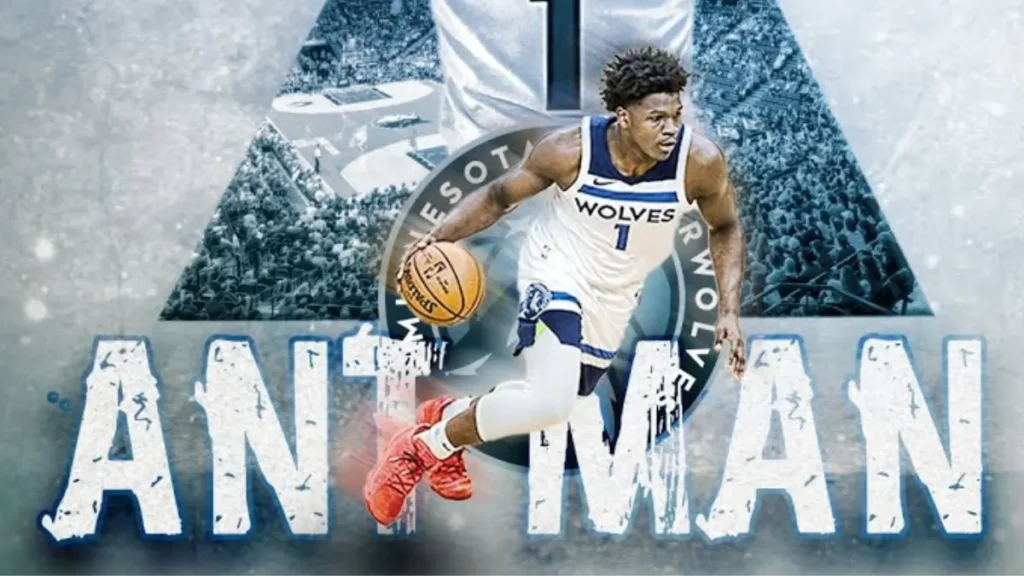
By year three, Edwards was not just a scorer. He was a nightmare. He posted a 44-point game in January 2023 that featured eight threes, six rebounds, three steals, and three blocks. The Timberwolves clawed their way into the playoffs through the play-in tournament, and when they arrived, Edwards did not flinch. He put up 36 points in his playoff debut against Memphis and posted a 30-plus point performance in the series-clinching game.
The 2023-24 season was when the national conversation changed completely. Edwards scored 51 points against Washington in April, hit his second All-Star nod, and made the All-NBA Second Team for the first time. Minnesota reached the Western Conference Finals. He was 22 years old.
Then came 2024-25 — arguably his most refined season yet. He averaged 27.6 points per game, shot 37 percent from three on over ten attempts per night, and led the entire NBA in three-pointers made. He also became the youngest player in NBA history to make 1,000 career threes. The scoring was no longer raw. It was surgical.
Conference Finals, Olympic Gold, and the Moments That Defined Him
Talent gets you to the big moments. Character defines what you do in them.
In the summer of 2024, Edwards joined Team USA for the Paris Olympics as one of the younger players on a roster packed with legends. LeBron James, Kevin Durant, and Stephen Curry were the headliners. Edwards was supposed to be in learning mode.
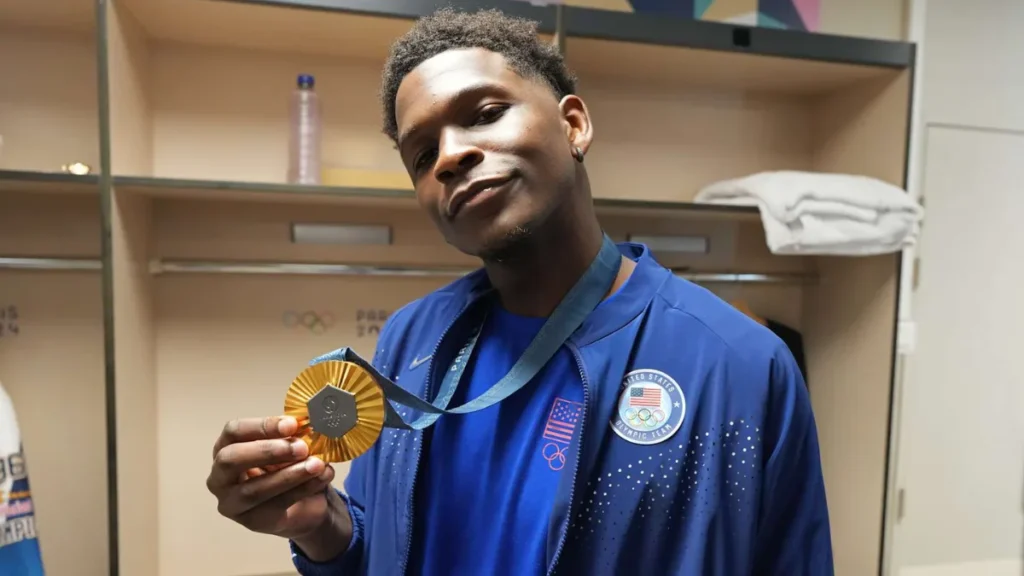
He did not read that memo. Coach Steve Kerr handed him primary scoring responsibilities off the bench and watched him shoot 58 percent from the field across six games, averaging 12.8 points per outing. Durant, who had watched Edwards closely throughout the tournament, told Olympics.com that Edwards approached the game with the same mentality he had — wanting to be the best every single day. Team USA beat France in the gold medal game. Edwards left Paris with a gold medal and an endorsement from two of the greatest players in NBA history.
The conference finals have told an equally revealing story. In the 2024 Western Conference Finals against Dallas, Edwards posted a near triple-double in a Game 4 win — 29 points, 10 rebounds, and nine assists. Minnesota ultimately lost the series in five games, but Edwards’ performance confirmed something the league had already suspected: this was not a player who disappeared when the stakes rose. This one grew.
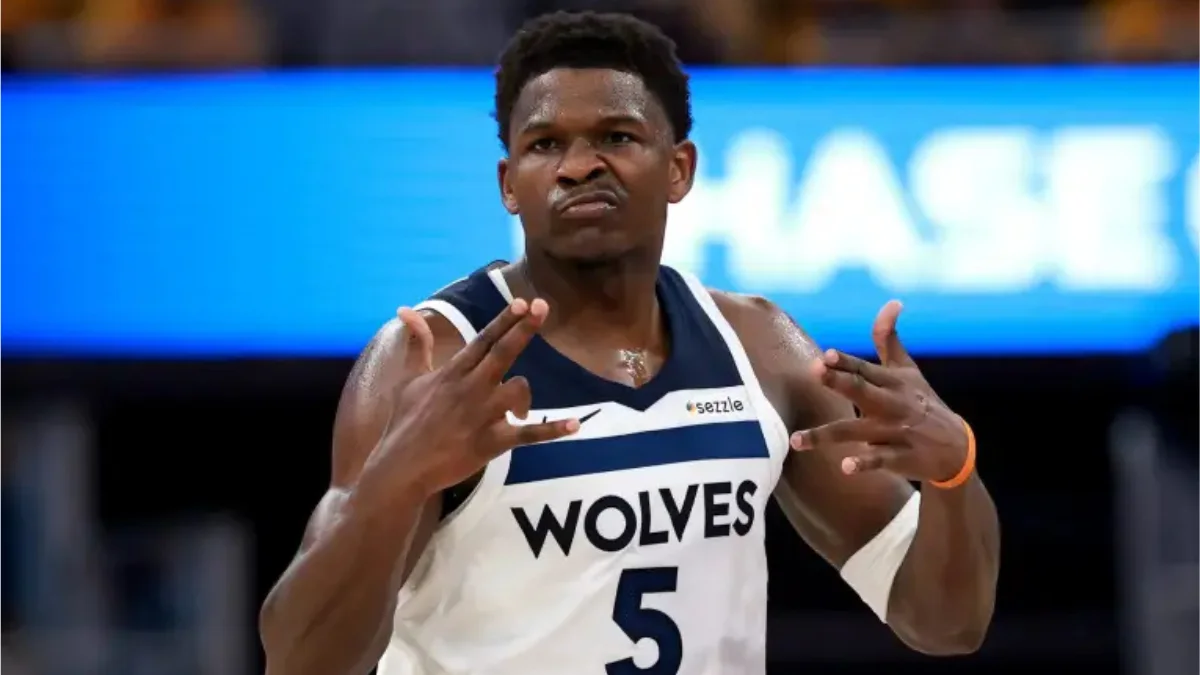
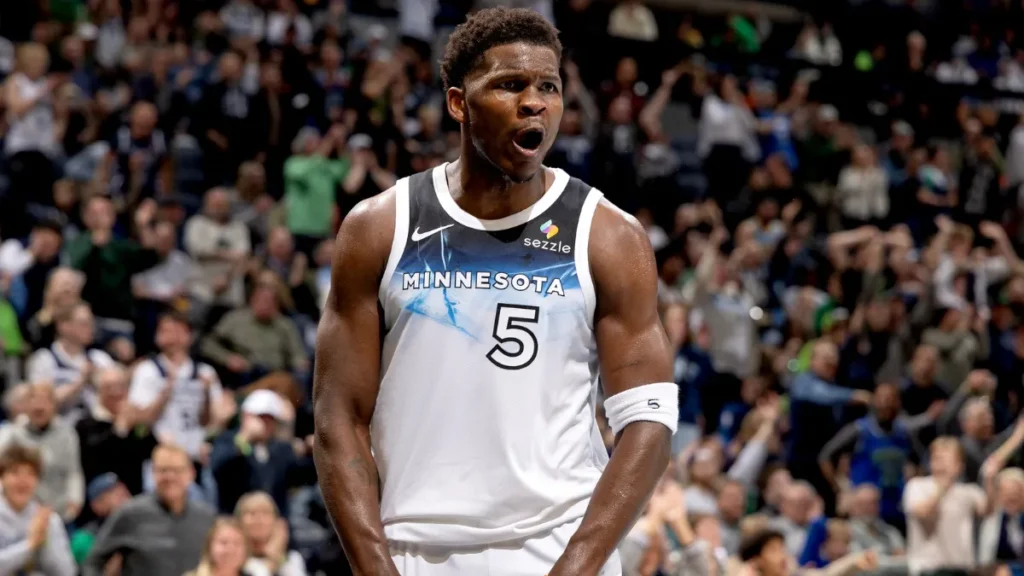
Then there was May 2026, a moment that stopped even the most casual NBA follower in their tracks. Edwards had hyperextended his left knee in the first round against Denver, absorbing a bone bruise alongside it. The medical staff estimated he would miss at least the first two games of the Western Conference Semifinals against San Antonio. He returned after ten days. In Game 1 on the road against the Spurs, he scored 11 of his 18 points in the fourth quarter, hit his first three-pointer of the night, turned to the Spurs bench, and screamed “I’m back!” Then in Game 4, playing through pain, he scored 36 points, including 16 in the final quarter, to tie the series 2-2. When asked after the game about his motivation, he said it was Mother’s Day, and he had lost his mother, Yvette, to cancer when he was in eighth grade. He wore the number 5 jersey because both his mother and grandmother died on the fifth day of the month. He was not going to lose that game for her.
What Separates Edwards from His 2020 Draft Class Peers
The 2020 class was widely panned before it even started. In retrospect, it has produced an extraordinary range of talent — it just took longer than expected to reveal itself.
LaMelo Ball won Rookie of the Year, made an All-Star team, and has flashed genuine brilliance. But injuries have been relentless. He has averaged just over 50 games per season across his career, and his Hornets have not reached the playoffs in his time there. The ceiling is real. The floor remains uncertain.
According to Britannica, Tyrese Haliburton, the 12th pick, has become one of the best playmakers in the league and carried Indiana to the NBA Finals in 2025. He and Edwards sit at the clear top of their draft class in terms of sustained production and playoff relevance. In most redraft exercises done in 2025, Edwards remains the unanimous first pick, and Haliburton moves dramatically up the board.
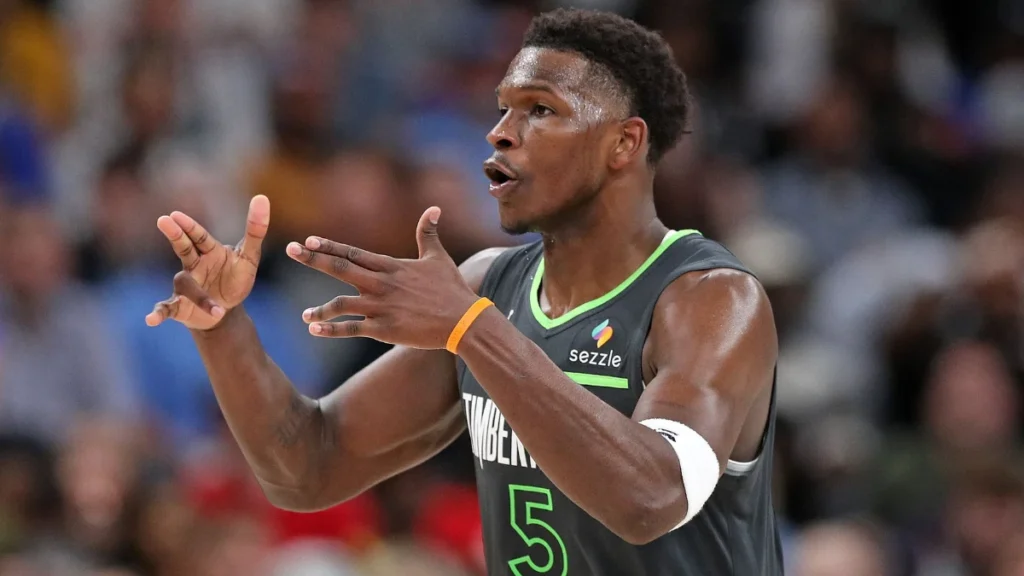
James Wiseman, the second pick, never found his footing at Golden State and remains a work in progress. The rest of the top ten — Patrick Williams, Isaac Okoro, Killian Hayes — have either plateaued or faded from the spotlight.
What separates Edwards from everyone in this class, including Haliburton, is a combination of physicality, shot creation, and the kind of magnetism that fills arenas. Haliburton is a more efficient playmaker. Edwards is the player you build your franchise, your marketing strategy, and your playoff hopes around. He plays with a confidence that borders on defiance, and it is contagious. The Timberwolves — a franchise that has had more 60-loss seasons than playoff series wins in its history — have now reached the Western Conference Finals in consecutive seasons. That did not happen by accident.
Can Anthony Edwards Lead Minnesota to Its First NBA Title?
The honest answer is: not yet proven, but absolutely possible.
Minnesota reached the Western Conference Finals in both 2024 and 2025 and lost both times — to Dallas in five and to Oklahoma City in five. The gap between the Timberwolves and an NBA title is real. Oklahoma City dispatched them in machine-like fashion in 2025, raising legitimate questions about whether the current roster construction can close the final two gaps.
But here is what makes this conversation different from the one happening in most other NBA cities. Edwards will turn 25 in August 2026. He is still getting better. His three-point volume this past season, his defensive engagement, and his ability to perform through injury — all of it points to a player who has not yet arrived at his ceiling.
The 2026 playoffs are still unfolding as of this writing, with Minnesota in the thick of a Western Conference Semifinals battle against San Antonio. The Timberwolves are now chasing a third straight conference finals appearance, something no team had done since the Golden State Warriors’ dynasty of 2018 and 2019. Edwards is fighting through a knee injury to make it happen.
The Ringer once called him “a preposterous athlete with a nice jumper and better instincts.” Former Knicks guard Langston Galloway called him the closest thing he had ever seen to Michael Jordan. Kevin Durant said he could not teach Edwards anything because he picks everything up so quickly.
Minnesota has never won an NBA title. The franchise drafted Kevin Garnett and watched him eventually leave. They watched Jimmy Butler sprint for the exit. Anthony Edwards has shown no signs of going anywhere. At 24 years old, with four All-Star appearances, an Olympic gold medal, and back-to-back conference final runs already on his resume, he is the reason to believe the story ends differently this time.
Anthony Edwards’ career arc is one of the great ongoing stories in professional basketball. Draft day was just the first sentence.