Chappell Roan turned down the White House. She walked out of her talent agency. She filmed the paparazzi right back. And somehow, every time Chappell Roan draws a line, the internet decides the problem is her.
Since her meteoric rise from a small-town Missouri girl to Grammy-winning pop sensation, the 27-year-old has been at the centre of one headline after another — not for the kind of scandals that involve infidelity or addiction, but for something far more threatening to the status quo: saying no.
The Chappell Roan controversy cycle is by now a pattern so predictable it has become almost its own genre. She makes a principled stand. The internet erupts. And then, slowly, the facts emerge and the narrative shifts.
Here is every major moment — documented, untangled, and placed in the context it actually deserves.
Why Chappell Roan Became a Lightning Rod for Public Controversy
There is a particular kind of celebrity the public tends to reward: the grateful one. The artist who thanks fans endlessly, who treats fame as an unconditional gift, who never speaks up when things feel wrong.
Chappell Roan is not that artist.
From the moment she broke through in 2024, largely on the back of her work opening for Olivia Rodrigo and the success of “Good Luck, Babe!”, she has been explicit about what fame means to her — and what it does not. In a viral TikTok early in her rise, she addressed fans directly: “I don’t care that abuse and harassment, stalking, whatever, is a normal thing to do to people who are famous,” she said. “That does not make it okay. That doesn’t make it normal. That doesn’t mean I want it.”
That statement alone made some fans uncomfortable. Because the unspoken contract of pop stardom — you give us everything, we give you love — was being publicly renegotiated, in real time.
That is the paradox at the heart of every Chappell Roan controversy. Authenticity is her brand. But the public, it turns out, loves authenticity only when it is convenient for them.
The White House Pride Refusal That Split the Internet
In June 2024, at the peak of her breakthrough summer, Chappell Roan announced something remarkable from the stage at New York’s Governors Ball festival, in front of 150,000 people.
She had been invited to perform at the White House for Pride Month. She said no.
“As a response to the White House, which asked me to perform for Pride,” she told the crowd, dressed as the Statue of Liberty, “we want liberty, justice and freedom for all. When you do that, that’s when I’ll come.”
The reason, she later revealed to Rolling Stone, was the Biden administration’s handling of the war in Gaza. She had initially planned to attend and had even selected poems by Palestinian women to read instead of performing her songs. But she ultimately declined, later explaining that she feared the political consequences for her family. “I had to find something that’s tasteful and to the point and meaningful,” she said.
The backlash was swift and confused. Progressive fans, who had lionised her as a queer icon, were furious that she was not endorsing the Democratic candidate. Conservative critics pounced on the spectacle. But what was largely missed in the noise was the clarity of her reasoning: she refused to be used as a symbol by an administration whose policies she found morally incompatible with the values that same administration was asking her to represent.
She was, in short, declining to be a decoration. And when the Biden administration subsequently walked back a statement on gender-affirming care for trans children, she noted simply: “Thank God I didn’t go.”
The Paparazzi Confrontation That Went Viral at Paris Fashion Week
March 2026 became the month that turned Chappell Roan into a cultural lightning rod all over again.
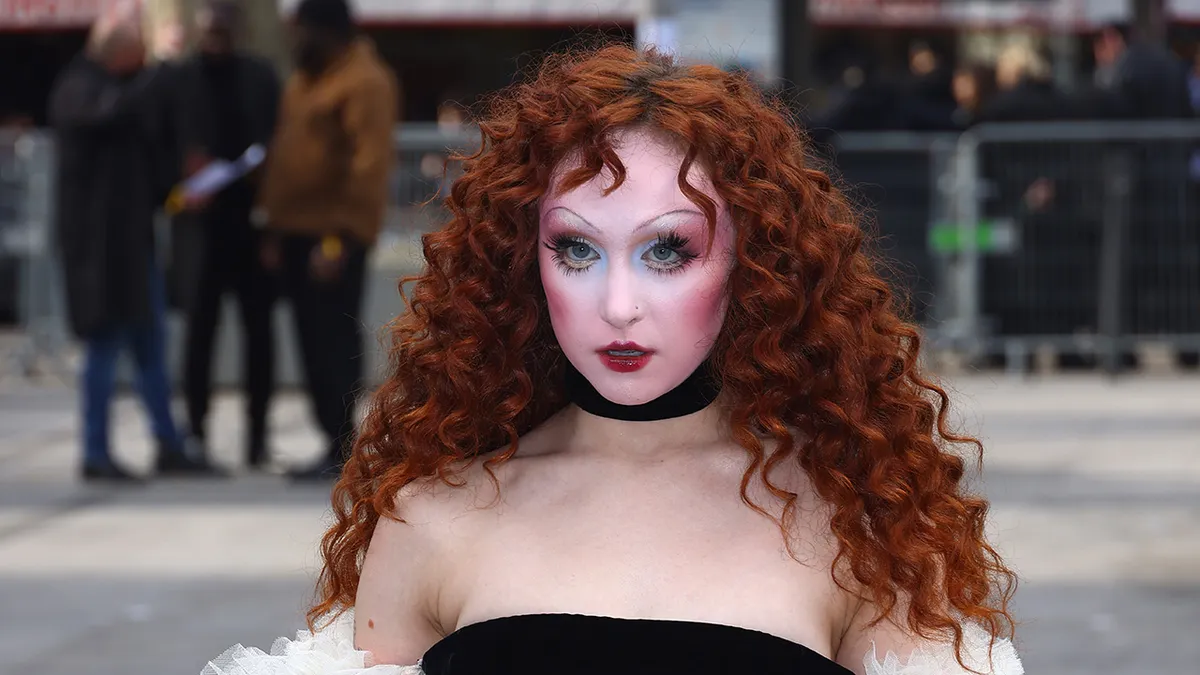
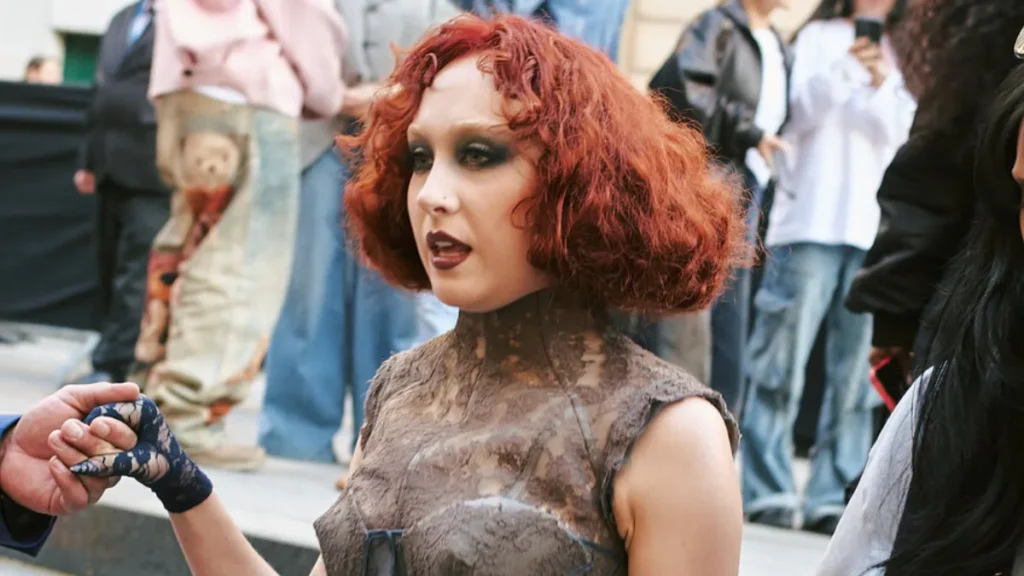
At Paris Fashion Week, a video began circulating that showed Roan, dressed in an elegant old Hollywood-style look, doing something almost no celebrity dares to do: she pointed her phone directly at the photographers surrounding her and filmed them back.
“When you’re disregarded as a human, this is what it’s like,” she is heard saying in the footage. “I’m just trying to go to dinner, and I’ve asked these people several times to get away from me.” She called out the photographers for “completely disregarding all of my boundaries” and for following her repeatedly.
The clip went viral. Responses split immediately along predictable lines. Supporters praised her for exposing the mechanics of paparazzi harassment. Critics, including some in the media, argued she had signed up for exactly this when she chose fame.
Even Boy George weighed in. Artists, including Noah Kahan and Doja Cat, came to her defence. Kahan made the important point that these interactions are deliberately manipulated to make boundary-setting look like fan hostility — warping the perception of an artist into someone who is “rude to fans when really they’re just manipulating you.”
The misogyny subtext was hard to ignore. No one lectures a male artist for declining to be photographed at dinner. But a woman who refuses, visibly and unapologetically, is reframed as difficult.
The Brazil Security Incident and a City’s Ban
Just days after the Paris footage went viral, a new controversy arrived — and this one was messier.
Brazilian professional soccer player Jorginho Frello posted to his Instagram Stories on March 21, claiming that Roan’s security guard had approached and berated his wife, Catherine Harding and her 11-year-old stepdaughter, Ada — who also happens to be actor Jude Law’s daughter — at a São Paulo hotel during breakfast. He alleged the child had simply walked past Roan’s table, smiled, and returned to her seat. No harassment. No interaction. According to him, a security guard then confronted the family and left Ada in tears.
The internet erupted. Given the recent Paris footage, the narrative was already primed: here was a difficult celebrity terrorising a child.
Roan responded quickly on her Instagram Stories. She stated clearly that she had not asked the security guard to approach the family and had not even noticed the child at the time.
Then, several days later, the security guard himself, Pascal Duvier, issued a public statement. “I take full responsibility for the interactions on March 21st,” Duvier wrote. “The actions I took were not on behalf of Chappell Roan, her personal security team, her management, or any other individuals.” It emerged that Duvier had not actually been working for Roan that day at all. His involvement was entirely independent of hers.
But the damage had already been done. Eduardo Cavaliere, the mayor of Rio de Janeiro, made a public declaration that Roan would never perform at the city’s Todo Mundo no Rio festival. The ban was issued before Duvier’s clarifying statement. No confirmed concert cancellations followed, and Roan’s MAC Cosmetics deal remained intact.
The incident is a case study in how quickly a story solidifies online before the facts are fully established — and how rarely the corrections travel as far as the original accusation.
Leaving Wasserman: When an Artist’s Ethics Become Business Decisions
Before the Brazil chaos even began, Roan had already made one of the boldest moves of her career — and it had nothing to do with music.
On February 9, 2026, Roan announced on her Instagram Stories that she was immediately parting ways with Wasserman, the powerful talent agency led by entertainment executive Casey Wasserman. Wasserman’s agency represents major names including Adam Sandler and Brad Pitt, and its founder also chairs the 2028 Los Angeles Olympics organising committee.
The reason: newly released Epstein files had revealed emails between Casey Wasserman and convicted sex trafficker Ghislaine Maxwell, including one in which Wasserman wrote, “I think of you all the time. So, what do I have to do to see you in a tight leather outfit?” The correspondence dated to 2003 and was made public as part of the Epstein Files Transparency Act, which Congress had passed in November 2025.
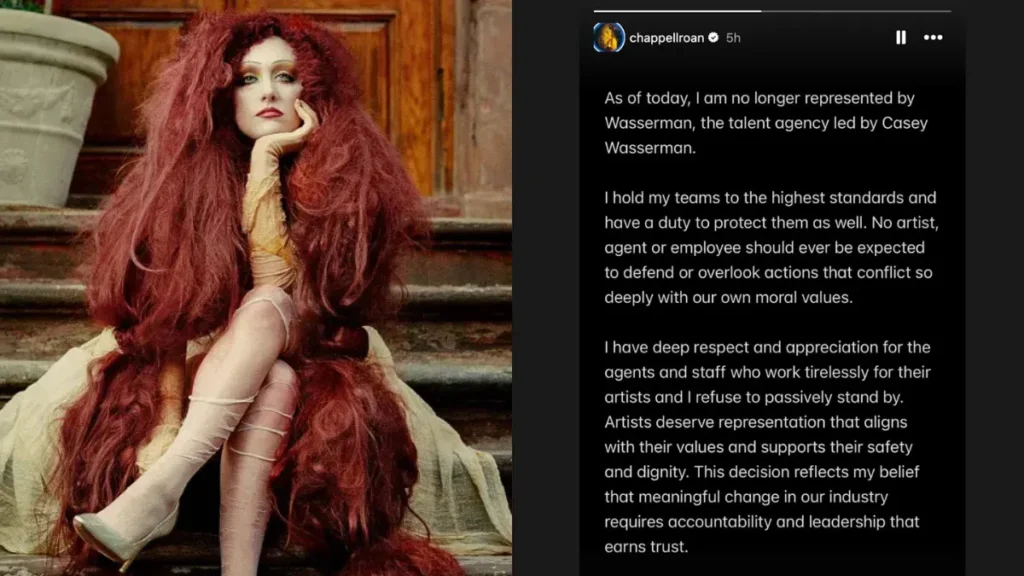
Roan’s statement was characteristically direct. “No artist, agent or employee should ever be expected to defend or overlook actions that conflict so deeply with our own moral values,” she wrote. “I hold my teams to the highest standards and have a duty to protect them as well. Artists deserve representation that aligns with their values and supports their safety and dignity.”
Wasserman acknowledged the emails while insisting he had no personal or business relationship with Epstein. He has not been charged with any wrongdoing. Still, Roan’s departure triggered a wave of similar statements from other Wasserman-represented artists. The alt-country band Wednesday posted their own announcement, beginning the process of leaving the agency. Bethany Cosentino of Best Coast published an open letter, writing: “Staying quiet isn’t something I can do in good conscience — especially in a moment when men in power are so often protected, excused, or allowed to move on without consequence.”
In an industry where artists routinely stay silent to protect business relationships, Roan’s decision to act on her stated values at a genuine professional cost was, by any measure, exceptional.
The “Rich Girl” Background Debate and the Benefit Concert Receipts
When the Brazil incident broke, online critics began doing what they always do when a public figure becomes newly vulnerable: they went looking for contradictions.
A viral TikTok claimed that Roan’s grandfather was a multi-millionaire who owned an expensive golf course, that she had a Republican uncle, and that attending a $3,000 Grammy camp as a teenager proved she had never been the working-class Midwest girl she presented herself as.
The framing was designed to undercut the authenticity that defines her public identity. If she came from money, the argument went, then the whole “Midwest Princess fighting from the bottom” narrative was manufactured.
There is a significant problem with this framing. The Springfield News-Leader reported in 2014 that a teenage Chappell Roan held a benefit concert specifically to raise money to pay for the Grammy camp in question. That single documented fact does not erase the complexity of family wealth, but it substantially complicates the “rich girl pretending to be poor” narrative being sold online.
The truth, as it usually is, is more nuanced. Roan has never claimed her family was impoverished. Her artistic persona draws on the cultural and emotional experience of growing up queer in a small Midwestern town, not on a specific income bracket. The distinction matters — and the social media version of this story largely ignored it.
The Grammy Outfit That Broke the Internet — and Her Response
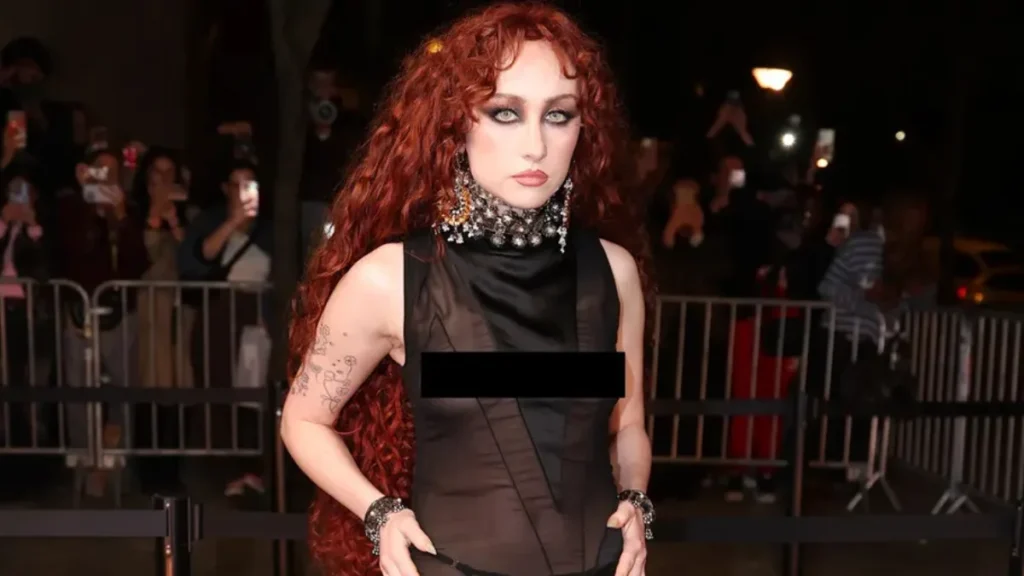
On February 1, 2026, Roan arrived at the 68th Grammy Awards in a custom Mugler gown — a revival of Thierry Mugler’s iconic spring/summer 1998 couture piece — that hung from prosthetic nipple piercings beneath a sheer maroon silhouette. Styled by longtime collaborator Genesis Webb, the look was an unmistakable art historical reference to one of fashion’s most provocative designers.
The internet did not greet it as fashion history. Much of the reaction treated it as a provocation at best and a moral failure at worst. “This USED to be a highly respected award show,” one commenter wrote. Others called it “attention-seeking” and “tacky.”
Roan’s response, posted to Instagram, was the most Chappell Roan response possible: “Giggling because I don’t even think this is THAT outrageous of an outfit. The look’s actually so awesome and weird. I recommend just exercising your free will, it’s really fun and silly.”
Stylist Genesis Webb added context that much of the backlash ignored: “They’re prosthetics, don’t take it down.”
The look was a deliberate artistic citation. It was also a pointed piece of commentary on how women’s bodies are simultaneously commodified and policed in the same spaces that claim to celebrate female artistry. That the Grammys — an institution that has spent decades profiting from female sexuality in performance — generated outrage over a piece of fashion couture said more about the institution than it did about the outfit.